


Conquest
Conquest is our game’s constructed format. In this mode all players create their own decks prior to the game’s start. Decks are made with up to 2 different piles of cards. A 40-60 card Arsenal and a 0-20 card Fountain.
Deckbuilding Rules
Arsenal: Your Arsenal must have at least 40 cards with a maximum of 60 cards. For tournament play all cards must be in the same sleeves. Your deck may include any number of Gambits, Passive, Actives, and Jumon cards. For each unique card name, you must include at least one playable stack and may put up to 3 times the cost of the card in your Arsenal capping at a max of 10 cards. For example, Scattershot, a 2 cost card, must have at least 2, and may have up to 6 copies in a legal deck. For cards with a cost of 4 or 5, like Dreadnaught Cannon, may only run a maximum of 10. Any Jumon cards you include must also be from the same Paragon and must match with the Genki you have in your Fountain. All Genki in the Fountain must also be the same Paragon. For decks that use Jumon cards in their Arsenal, there must be at least 1 Genki of the matching Paragon in your Fountain.
Fountain: A fountain contains a maximum of 20 total cards, and may only consist of Finesse and/or Genki. You are allowed to mix Genki and Finesse (ex. 5 Genki, 15 Finesse or 10 of each), however Genki may only be from 1 Paragon, and that Paragon must match any Jumon in your Arsenal. All Finesse are treated the same, and any artwork may be used for this resource.
Sideboard: Your Sideboard is an optional group of cards that can be interchanged with cards from your Arsenal during a Match. These cards are limited to Jumon (of the matching type as your main deck), Gambit cards, or any card with the Tag “Generator”. You may also only run the legal amount (see “Arsenal” above) of any given card, with the total number factoring in both your Arsenal and Sideboard.
After the first game of a Match, you may interchange any cards in your Sideboard with cards from your Arsenal. Your Arsenal must still contain the legal number of 40-60 cards at all times. The Match will continue to the next game once all players have concluded this process.
Gladiator
Gladiator is a unique and challenging game format that puts players’ deck-building skills to the ultimate test. Unlike constructed formats where players bring pre-built decks, Gladiator is a Draft format, meaning participants construct their decks on the fly from a shared pool of cards. This dynamic process requires players to adapt their strategies, identify powerful card synergies, and make quick decisions under pressure.
Once drafting is complete, players move on to the deck-building stage. With their newly acquired collection of cards, they must craft a cohesive and effective deck. The goal is to create the strongest possible deck from their available cards, one that can outmaneuver and outplay opponents in a much more improvised combat scenario.
Deckbuilding Rules
Arsenal: To build an Arsenal in Gladiator, you will be drafting cards from Armory packs. Each player will be given an Armory pack to start. After looking through their pack, they will select and take out 4 copies of a matching card. Once all players have chosen their card, you will pass the remaining cards in the pack clockwise and repeat the process, taking 4 copies of a matching card from each pack passed, until there are no more cards to pass around. At the end of this process, you may immediately interchange or add any cards from your Sideboard to make your Arsenal.
Fountain: A fountain contains a maximum of 20 total cards, and may only consist of Finesse and/or Genki. You are allowed to mix Genki and Finesse (ex. 5 Genki, 15 Finesse or 10 of each), however Genki may only be from 1 Paragon, and that Paragon must match any Jumon in your Arsenal. All Finesse are treated the same, and any artwork may be used for this resource.
Sideboard: Your Sideboard is an optional group of cards that can be interchanged with cards from your Arsenal during a Match. These cards are limited to Jumon (of the matching type as your main deck), Gambit cards, or any card with the Tag “Generator”. You may also only run the legal amount (see “Arsenal” above) of any given card, with the total number factoring in both your Arsenal and Sideboard. For your Sideboard, you are not allowed any cards that belong to the legendary rarity.
After the first game of a Match, you may interchange any cards in your Sideboard with cards from your Arsenal. Your Arsenal must still contain the legal number of 40-60 cards at all times. The Match will continue to the next game once all players have concluded this process.
Team Size
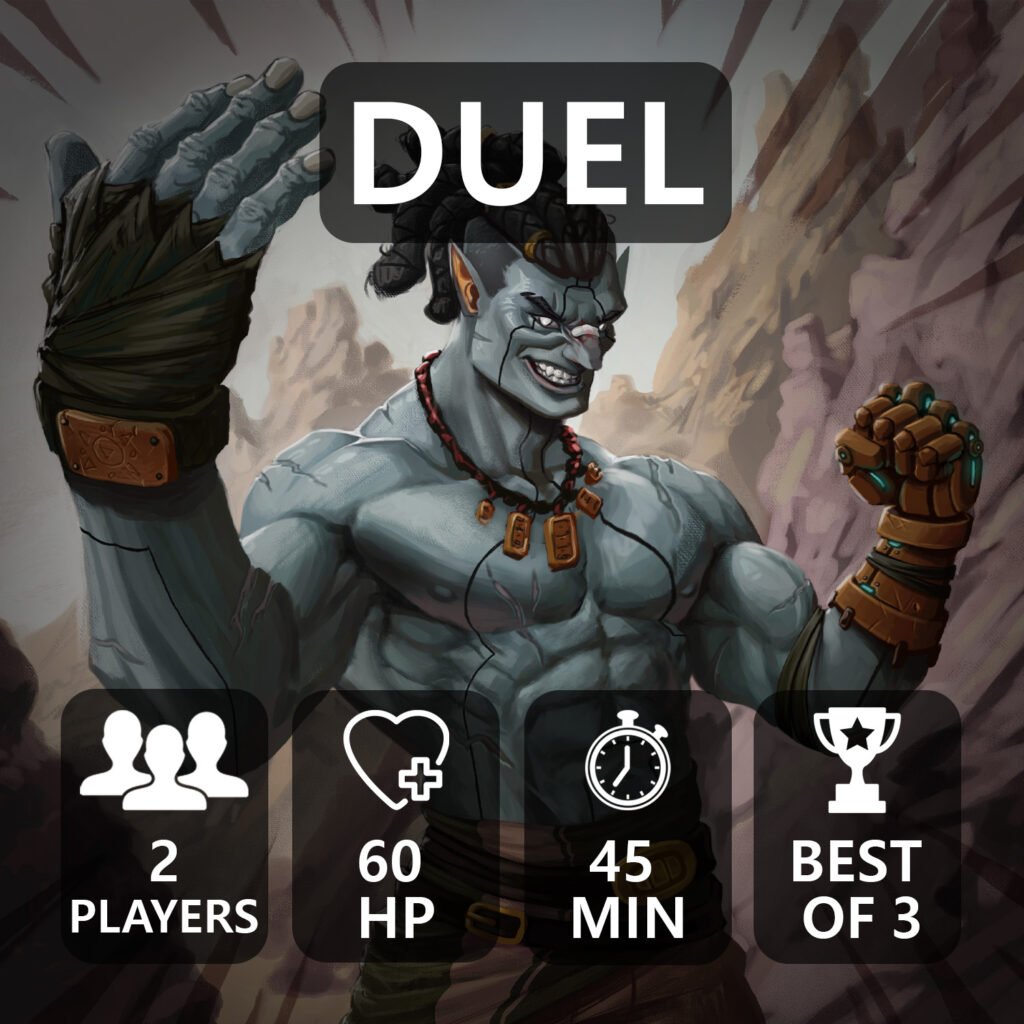
The core competitive format of Hadrai’da: Ascendant, Duel Mode pits two players against each other in a one-on-one clash of strategy, skill, and willpower. Whether armed with a custom Conquest deck, or playing in the improvisation-heavy Gladiator format, players enter the arena to engage in fast-paced, tactical combat, each turn bringing them closer to triumph or defeat. In this high-stakes battle for supremacy, only one will rise.
Gameplay
To begin, both players roll 1d20, re-rolling any ties until there is a winner. The winner of this roll decides who goes first in the turn order. Player 1 (the player chosen to go first) takes their turn, playing cards and attacking, and is then followed by Player 2 who does the same. This constitutes a single round. Once both players have completed their turns, the round ends and a new round begins with Player 1. The game will repeat as such until a winner is decided or until the timer runs out, if playing in a tournament. In the case of the latter, the player with the higher HP total at the called end time will be declared the winner of that match.
When playing in tournaments, matches will be the best of 3, and in-between matches, players may swap cards in and out of their Arsenals and Sideboards, adhering to the standard rules outlined in the “Sideboard” section above. The turn order for the second match in a best of 3 is determined by the loser of the first match. The turn order for the third match, if needed, is determined once again by rolling 1d20, with the winner of the roll (reroll ties) being given the ability to choose the turn order.
Objective
The goal of this game is to be the last player standing. If your opponent’s HP pool has been reduced to ≤ 0, or they have no cards remaining in both their Scrapyard and Arsenal, you win the game.
The goal of the match is to win 2 games before your opponent.
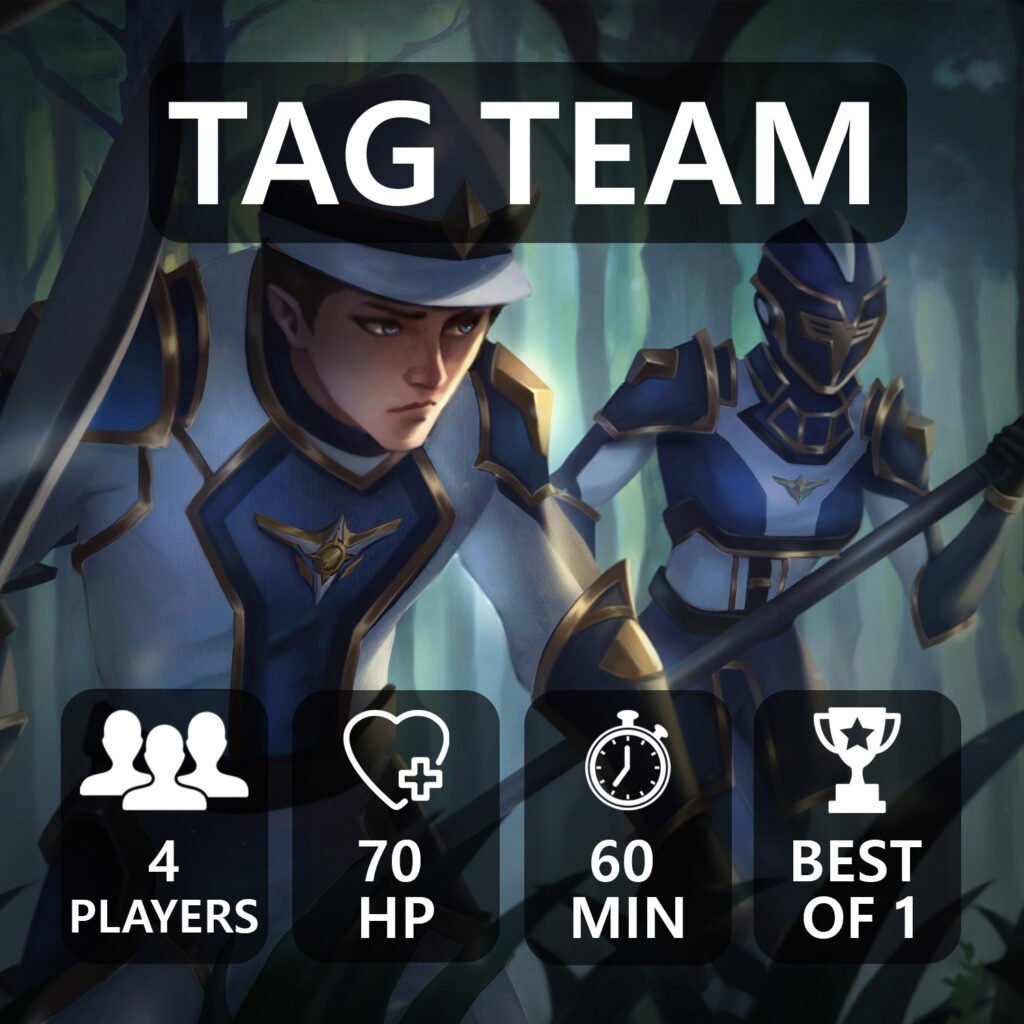
Step into coordinated chaos with Tag Team mode, where two-player teams face off in a 2v2 showdown. Communication, synergy, and timing are everything as teammates combine their strategies, support each other’s plays, and execute synchronized combos to outwit and outlast their opponents. Victory isn’t just about individual skill, it’s about trusting your partner and striking as one.
Gameplay
Each player will grab a Formation Token with a front side, “Frontline”, and a back side, “Backline”.
To begin, all players roll 1d20, re-rolling any ties until there is a single winner. The winner of this roll decides what team will go first. Teams will then determine amongst themselves the turn order for their members. Turn order will always alternate back-and-forth between teams and is decided from left to right amongst the table. If one player is defeated, the other player will take a second turn each round in their stead at the appropriate time in the turn order. At the start of the game all players will have their turn tokens face down.
During the start of a player’s turn, their turn player’s Formation Token will default to “Backline”. If they choose to play cards during their Opening Phase, they must then flip their token to “Frontline”. Their token will remain on the “Frontline” side until the start of their next turn the following round.
If all of a team’s Formation Tokens are set to the same side, either “Frontline” or “Backline”, then the opposing team may target either player with their attacks. If one of a team’s tokens is set to “Frontline”, while the other is set to “Backline”, then the opposing team must attack the “Frontline” player. Only if the turn player has the ability to make multiple attacks in a single turn (See “Barrage” in the Glossary Section) are they able to target the “Backline” player, so long as 1 of their attacks targets the “Frontline” player first. Other card effects that deal direct damage may target “Backline” players.
Objective
The goal of this game mode is to be the team with the last player(s) standing. Once a team has no players remaining, they lose and the other team will be the winner!
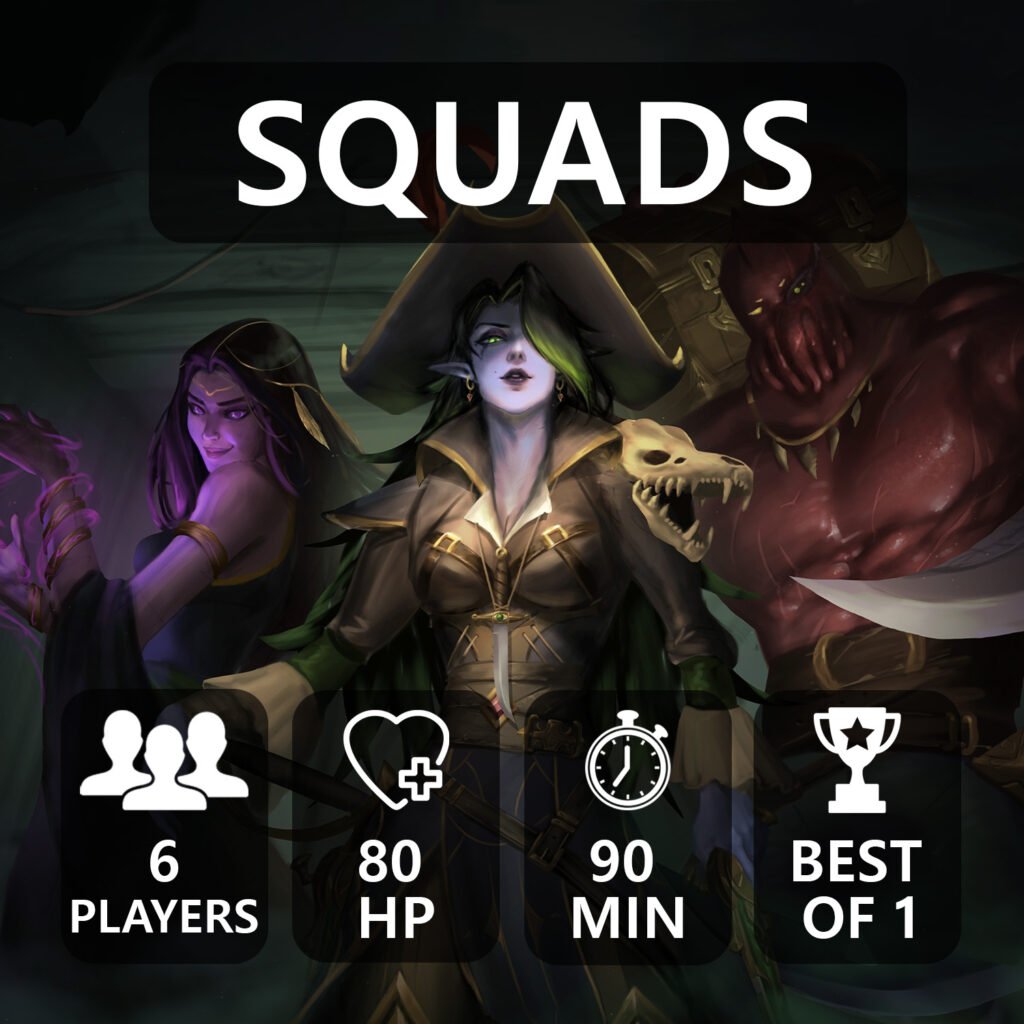
In Squads, three-player teams enter the battlefield in an all-out 3v3 war. With more players comes more unpredictability and more opportunity for tactical depth. Team roles, layered support, and well-timed plays can shift the tide of battle in an instant. Only the most coordinated squads will rise through the ranks and claim dominance over the field.
Gameplay
Each player will grab a Formation Token with a front side, “Frontline”, and a back side, “Backline”.
To begin, all players roll 1d20, re-rolling any ties until there is a single winner. The winner of this roll decides what team will go first. Teams will then determine amongst themselves the turn order for their members. Turn order will always alternate back-and-forth between teams and is decided from left to right amongst the table. Once one player is defeated, the game will automatically end once the current round finishes. Any players who have yet to take their turn this round will do so as normal, and any surviving, non-turn players may still activate cards on the Battlefield if appropriate. Once the round finishes, teams will add up the HP totals of all surviving players and the team with the highest total HP wins the match.
During the start of a player’s turn, their turn player’s Formation Token will default to “Backline”. If they choose to play cards during their Opening Phase, they must then flip their token to “Frontline”. Their token will remain on the “Frontline” side until the start of their next turn the following round.
If all of a team’s Formation Tokens are set to the same side, either “Frontline” or “Backline”, then the opposing team may target either player with their attacks. If one of a team’s tokens is set to “Frontline”, while the other is set to “Backline”, then the opposing team must attack the “Frontline” player. Only if the turn player has the ability to make multiple attacks in a single turn (See “Barrage” in the Glossary Section) are they able to target the “Backline” player, so long as 1 of their attacks targets the “Frontline” player first. Other card effects that deal direct damage may target “Backline” players.
Objective
The goal of this game mode is to be the team with the most HP remaining after the Final Stand round. If teams are tied in HP totals, the team with the most surviving members wins. If teams are tied in surviving members, each team will pick a representative out of the surviving members to partake in a Final Stand match.
In a Final Stand, the two chosen players each have their HP set to 10 and will roll 1d20 to determine who attacks first. Once turn order has been decided, players will take turns making Melee attacks only (Counterattacks still possible) until one side has reduced the HP of their opponent to ≤ 0. The surviving player’s team is declared the winner.
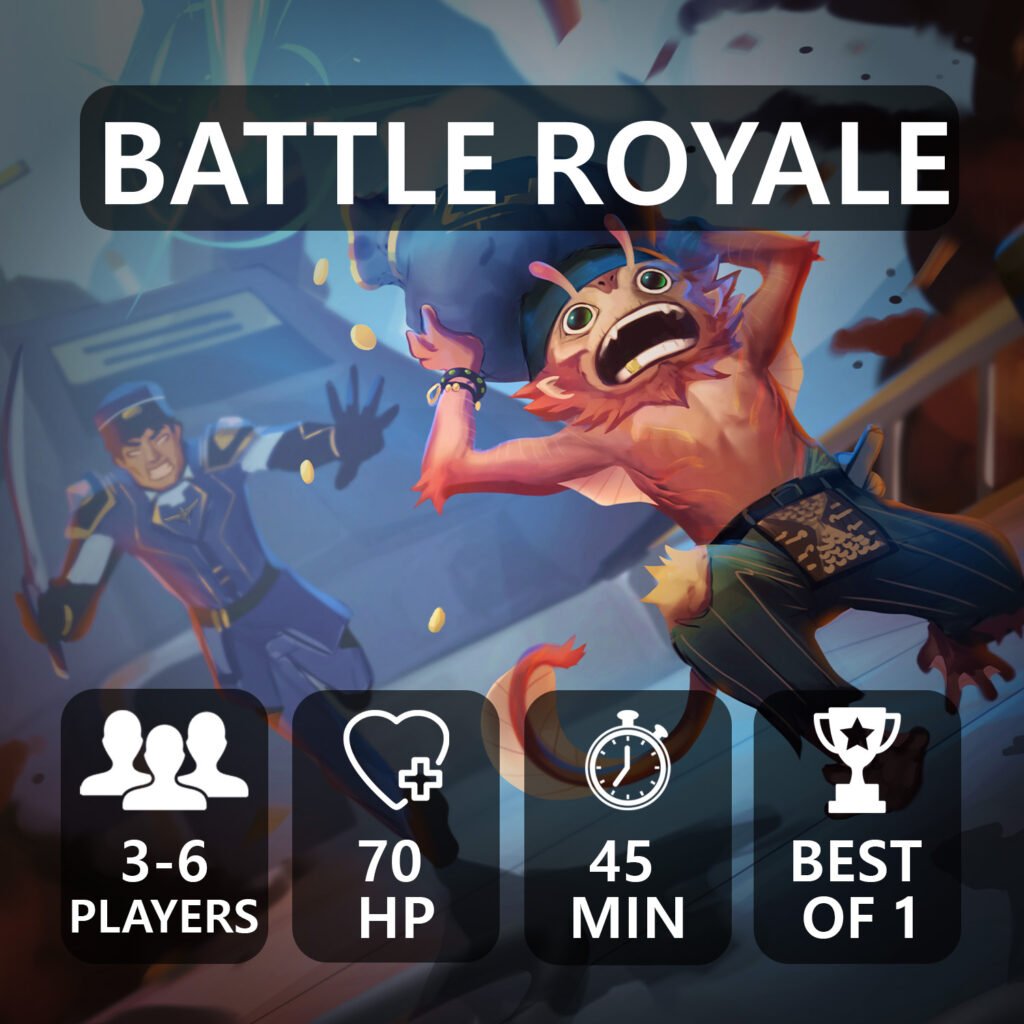
Every player for themselves. In Battle Royale, 3–6 players face off in a free-for-all frenzy where alliances are temporary and betrayal is inevitable. There are no teams, no safety nets, just pure competitive chaos. Survive the onslaught, outplay the competition, and be the last combatant standing.
Gameplay
To begin, all players roll 1d20, re-rolling any ties until there is a single winner. The winner of this roll decides who will go first. Turn order will always go clockwise from the starting player. All players may attack any other players in the match. Once one player is defeated, the game will automatically end once the current round finishes. Any players who have yet to take their turn this round will do so as normal, and any surviving, non-turn players may still activate cards on the Battlefield if appropriate. Once the round finishes, the player with the highest total HP wins the match.
Objective
The goal of this game mode is to be the player with the most HP remaining. If players are tied in HP totals, they will partake in a Final Stand match.
In a Final Stand, all participating players each have their HP set to 10 and will roll 1d20 to determine who attacks first. Once turn order has been decided, players will take turns making Melee attacks only (Counterattacks still possible) until only one player remains. The surviving player is declared the winner.
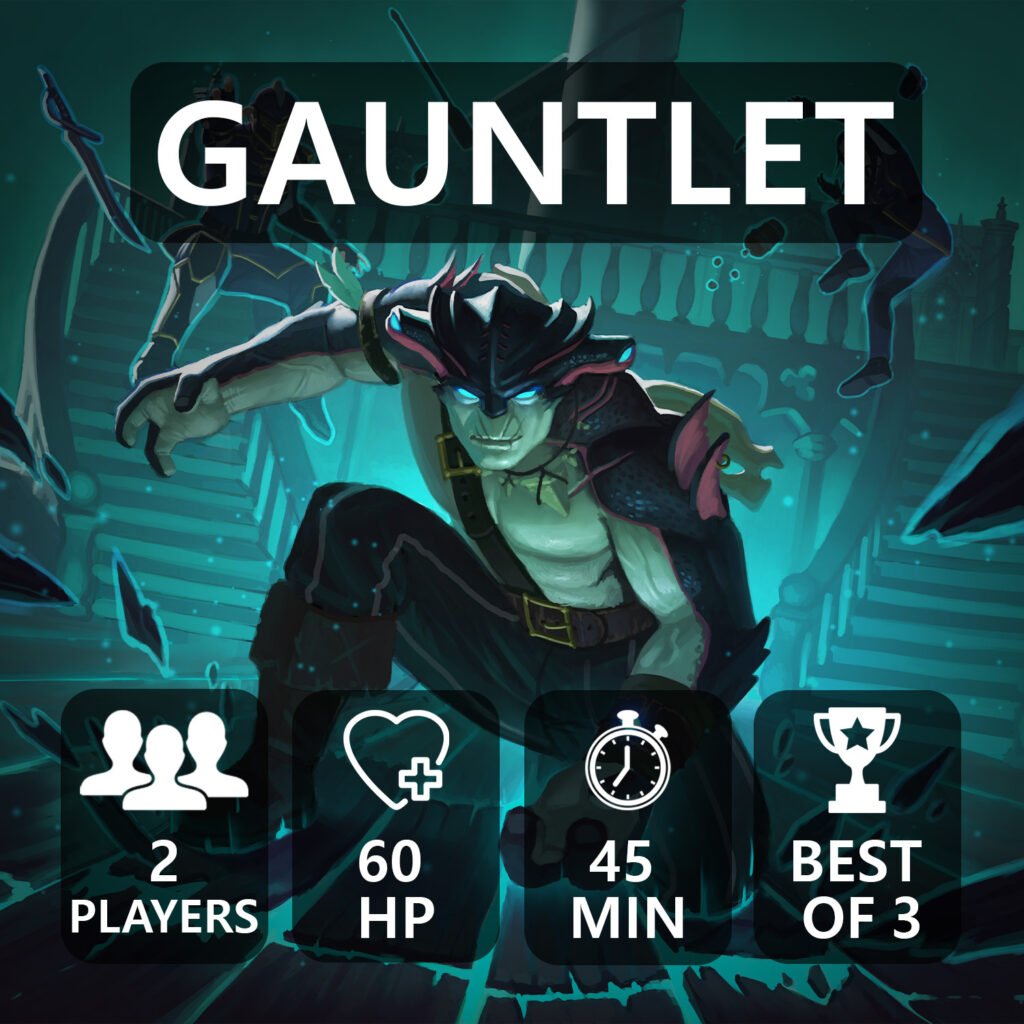
A grueling test of adaptability and endurance, Gauntlet mode is a Duel Mode variant where challengers face a series of consecutive 1v1 battles with a twist: you can’t use the same deck twice. Each victory brings you closer to glory, but every new deck demands a fresh strategy. Only the most versatile players, capable of mastering multiple playstyles, will conquer the Gauntlet.
Gameplay
The rules for this mode are the same as Duel with one exception. Players may not use the same deck (Arsenal, Fountain, Sideboard) across multiple games. Hence, each player must build 3 total decks to use. Each one represents a different “character”. At the start of each game, each player will choose 1 of their “characters” to play with. They will compete in 1 game using Duel Gameplay rules. Once a player has won that game, the players will then select one of the two remaining unused “characters”. Repeat this for the 3rd match with the 3rd “character” if necessary.
Objective
The goal of this game is to be the last player standing. If your opponent’s HP pool has been reduced to ≤ 0, or they have no cards remaining in both their Scrapyard and Arsenal, you win the game.
The goal of the match is to win 2 games before your opponent.
