

Game Objective
Ascendant is a first-person trading card game (TCG) that combines cards and dice to create fast-paced, tactical combat. As the player, you take on the role of the combatant, building a deck of 40 to 60 cards that represent your weapons, skills, and abilities.
During the game, you’ll use these cards, along with twenty-sided dice (d20s), to battle your opponent, manage resources, and try to reduce their health to zero before they do the same to you.
Whether you’re new to TCGs or a seasoned strategist, Ascendant invites you to think on your feet, adapt your tactics, and fight your way to victory.
Ascendant is designed for all kinds of players, whether you’re here for creative fun or competitive challenge. Set in the rich and evolving World of Kylia, the game invites you to explore its depth at your own pace. Whether you’re battling friends at home or competing in a tournament, Ascendant delivers thrilling, strategic gameplay that rewards both bold ideas and sharp instincts. So build your deck, grab your dice, and take your first steps toward becoming Ascendant.
Getting Started
Components
Lets take a look at the components of a standard game of Ascendant! There are two main components to the game, cards and dice.
In Ascendant, cards fall into two main categories: Arsenal cards and Stamina cards, each playing a vital role in how you build your strategy and fight your battles.
Arsenal cards make up your main deck and represent your core weapons, techniques, and abilities. These are the cards you’ll use in tandem with your dice to attack, defend, and outplay your opponent. There are four types of Arsenal cards, indicated by the letter in the top left and bottom right of the card:
Active Cards – These cards must be activated to use their effects. To activate an Active, simply rotate it horizontally (tap) while it’s face up on the board.
Passive Cards – These cards provide ongoing effects that stay in play as long as the card remains on the board.
Gambit Cards – Limited-use cards that are discarded or removed after being played. They’re perfect for quick, tactical plays when you need a boost.
Jumon Cards – Powerful spell cards fueled by Genki. Jumon can function like Actives, Passives, or Gambits depending on the card—they provide a bigger payoff but cost more to use.
Stamina cards, on the other hand, act as the energy source that help power cards in your Arsenal. These are kept in a separate side deck called the Fountain, and come in two types:
Genki Cards – Represent the mystical energy that powers Jumon spells. Genki cards are required to use Jumon cards and must be the matching Paragon.
Finesse Cards – Represent the ability to perform physical feats beyond the normal. Some Actives, Passives, or even Jumon may have bonus effects that cost Finesse, but Finesse is not a requirement to be able to use those cards.
Card Anatomy
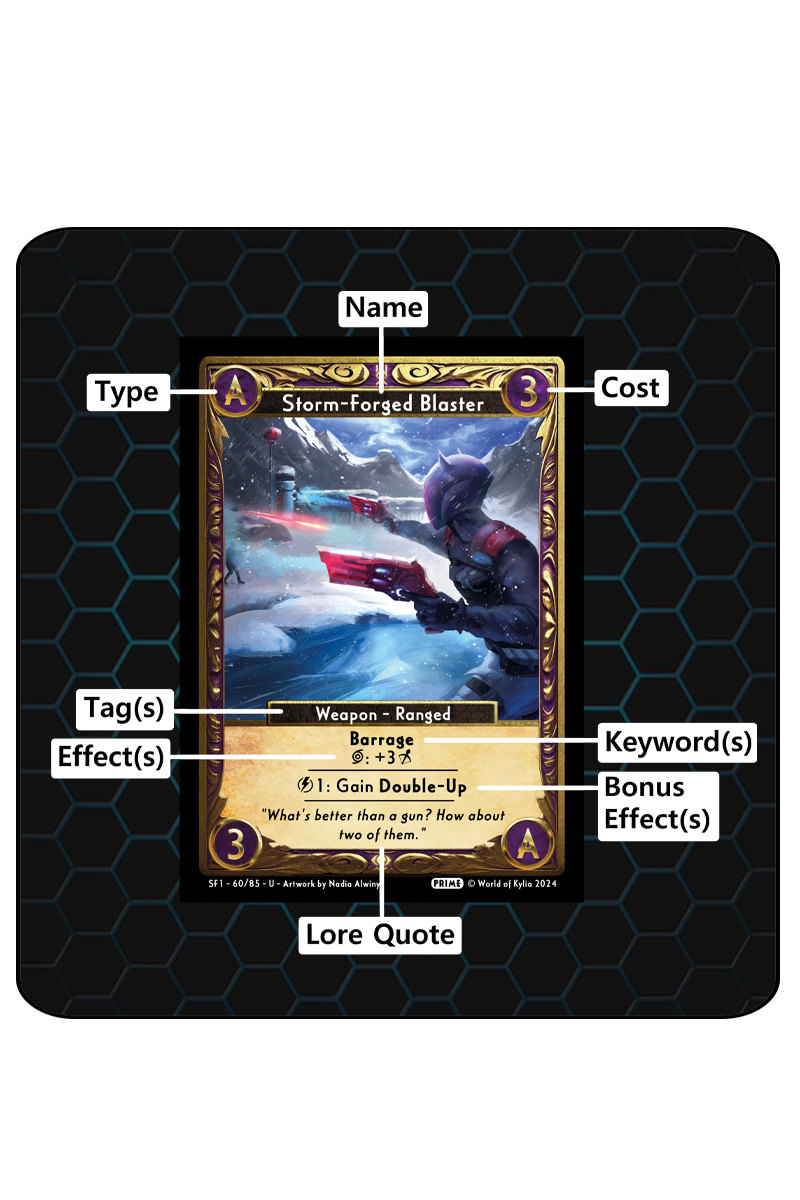
Name – The card’s name, important for deck building and some card effects
Type – The kind of card indicated by letter or symbol; Either Active, Passive, Gambit, Jumon, Genki or Finesse
Cost – The number of copies of the card required to be able to play it to the Battlefield from the Hand
Tags – Important traits and attributes of the card that help to classify it
Effects – This is the standard effect of the card. Cards that have a symbol followed by a “:” indicate that the ability is a paid effect. This can be through resources, turning the card sideways, or a condition
Keywords – These are words that give a card a passive ability or condition which effects how the card is used
Bonus Effects – These are effects that are used in addition to the main cards effect. Some of these bonus effects will have a paid cost and some will behave as passives.
Lore Quote – This is a non gameplay section that gives you a glimpse into the World of Kylia
Card Stacks
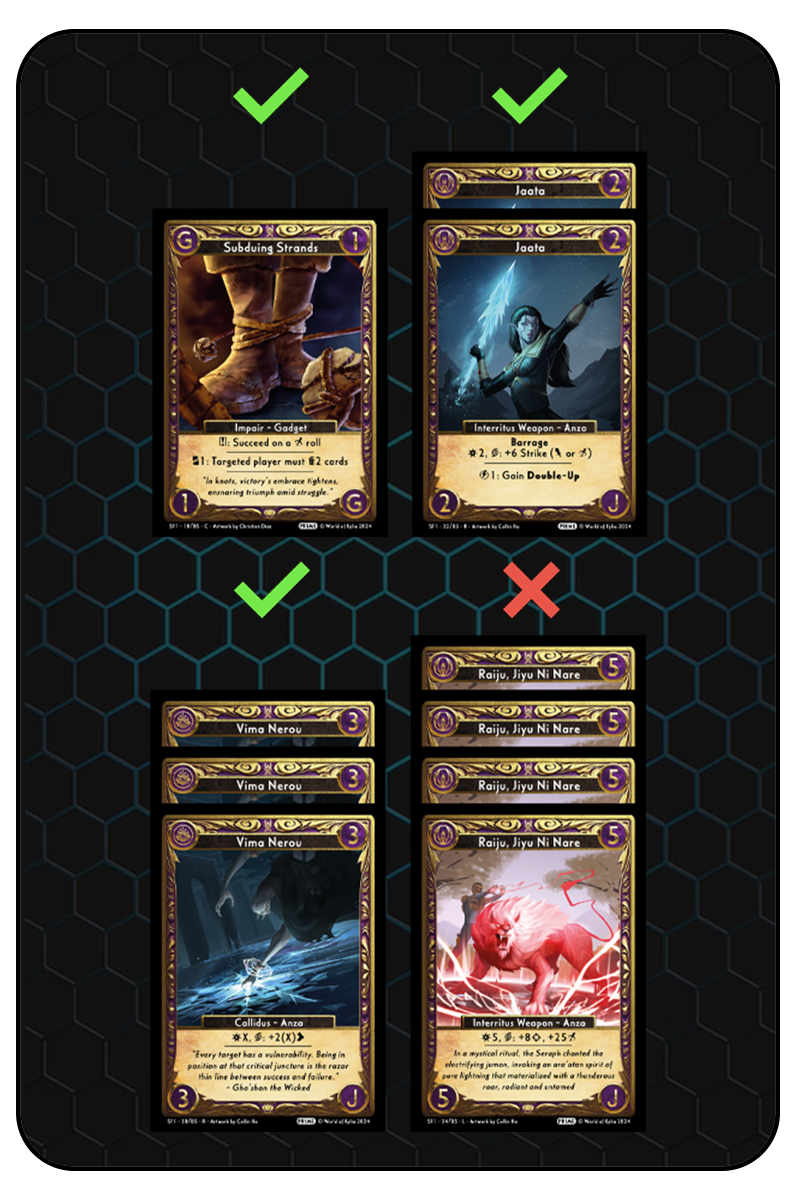
In Ascendant, cards are played by paying their cost, which is determined by the cards themselves. Each card has a cost indicated in the top right and bottom left corners. To play a card with a cost of 2, you must have 2 identical copies of that card in your hand. During the Opening Phase at the start of your turn, you can play the card by placing it in a stack.
For instance, in the example provided, all stacks meet the required amount to play except for Raiju. If you only have 4 Raiju cards in your hand, you must wait until you draw a 5th matching card before it can enter your Battlefield.
Once cards are on the field, they function as a single entity. Turning a stack will cause all cards within that stack to turn as well. In addition to serving as the cost, stack size has various other gameplay uses. The size of a stack can also be considered the durability of that card, as some effects can break cards.
Dice
When playing Ascendant, the core gameplay mechanic revolves around the use of 20-sided dice (d20s). You will roll these dice to determine whether or not you deal damage to your opponent and vice versa. While the game is technically playable with a single d20 die, multiple are recommended for ease of play and convenience.
Combat Roles
When calculating a combat roll, there are several factors that must be considered. In the most basic scenario, you will simply look at the roll(s) made and determine who succeeded or failed. For contested rolls, this is the person who rolled higher or lower. For non-contested rolls, this is subject to the conditions of the specific roll (ex. Aim requires a player to roll > 10).
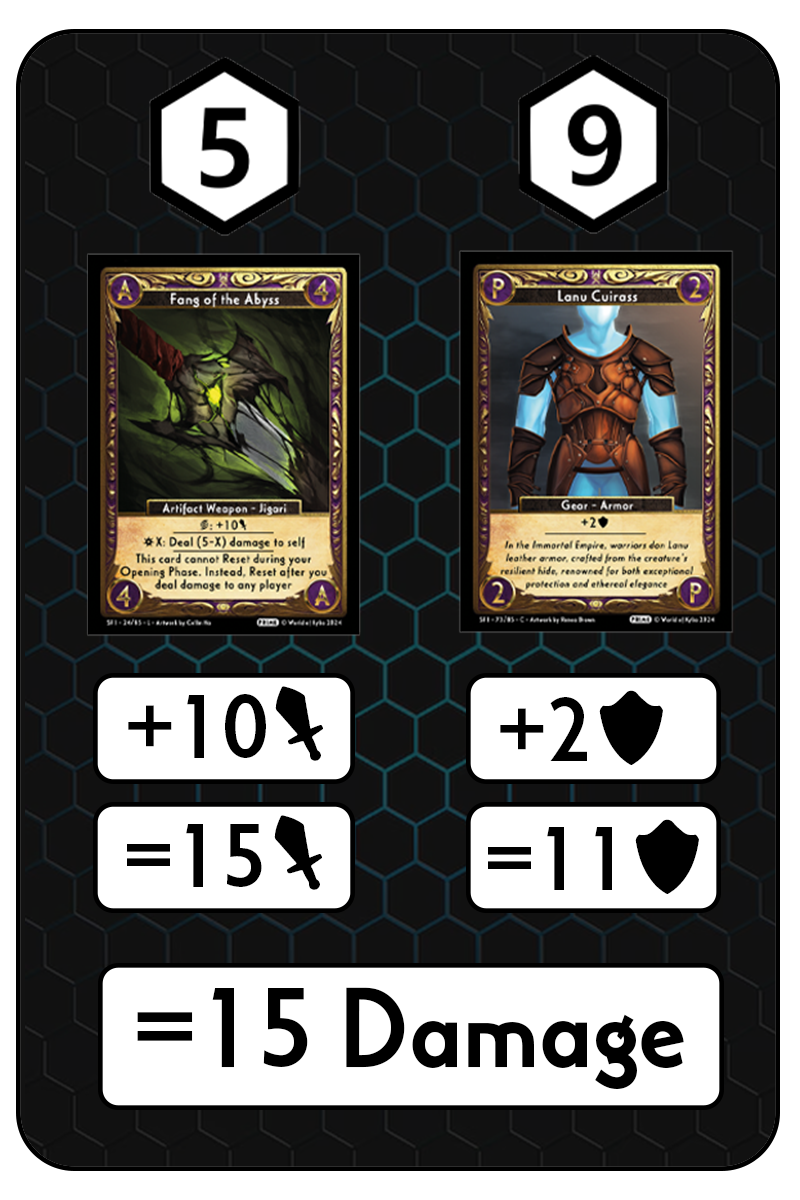
Combat rolls can also be affected by modifiers from cards. These modifiers might provide flat bonuses, like +5 to a roll, or allow you to reroll your original result and take the higher result. To calculate a combat roll with modifiers, simply add or subtract any relevant modifiers for that specific roll to the original result of your die. (ex. a die roll value of 5 + card modifiers that give +10 = a total roll result of 15). When the roll is contested, compare the final totals for each roll to determine who succeeded or failed. When the roll is non-contested, use the final total in comparison with the predetermined roll requirements to determine success.
Depending on the Phase of Play and the specific combat roll you are making, different cards and requirements exist. Please refer to the section titled “Gameplay” for more information on how combat rolls work.